Hrmony Embedded API — Partner (EN) (1.0.0)
Download OpenAPI specification:
Operations that concern the whole partner scope rather than a single organization: creating and listing organizations, managing webhooks.
Backend JWT via the client_credentials grant. Tokens are not issued by
this gateway but by its own subdomain, auth.<partner>.hrmony.rest:
curl --request POST \
  --url https://auth.<partner>.hrmony.rest/oauth/token \
  --header 'Content-Type: application/x-www-form-urlencoded' \
  --data grant_type=client_credentials \
  --data client_id=<CLIENT_ID> \
  --data client_secret=<CLIENT_SECRET> \
  --data scope='partner:read partner:write'
<partner> is the subdomain assigned to the partner; Hrmony provides
client_id and client_secret during onboarding.
The response carries access_token, token_type: Bearer and expires_in.
Send the token as Authorization: Bearer <access_token>. This tier has no
refresh tokens — once a token expires, request a new one through the same grant;
cache it server-side and renew it before it expires.
For this tier the authorization server has exactly two endpoints: the
POST /oauth/token above, and GET /.well-known/jwks.json carrying the public
key that issued tokens can be verified against. Both live on the auth subdomain rather than on
this gateway, so they do not appear in the endpoint list below — the example above
is their complete description.
Credentials and scopes
Hrmony issues one client_id/client_secret pair per partner installation.
That pair is deliberately valid on all three tiers — it is not an access right
in itself, only the permission to have tokens issued. What a call may do is
decided by the issued access token alone:
- A token belongs to exactly one tier. Scopes from two tiers in one
request are rejected with
400 invalid_scope, and the other two tiers' gateways reject a token of this tier with401. - A token carries exactly the scopes requested.
scope=partner:readyields a read-only token: write endpoints then answer403(/errors/forbidden). EveryGETis a read, everyPOSTa write. For use cases that only read — a back office, say — this is the intended route: a token of its own with the smallest sufficient scope rather than one token holding every right. - The required scope is stated on every operation in this specification as
x-required-scope.
On request Hrmony issues several client_id/client_secret pairs for the same
installation — one per connecting system, say, so that one can be replaced
without touching the others. A credential cannot be restricted to particular
tiers or scopes; the separation happens on the token.
Requests on this tier do not run in the context of an organization and
therefore carry no X-Hrmony-Tenant-ID header. Where an organization is
relevant at all, it is named as a path parameter (GET) or in the body
(POST). Everything that happens inside one organization lives on the admin
tier.
The events documented under webhooks describe requests Hrmony sends to the
partner, not endpoints of this API. Receiver URLs are registered through this
tier's /v1/webhooks endpoints; every delivery is signed so the receiver can
verify it.
Write endpoints carry a verb in the path: POST …/employees/create rather
than POST …/employees. This is deliberate.
The style is hybrid by design:
- Writes are RPC. The path names the action, the body carries the data.
- Reads are REST.
GET …/{id}, parameters in the URL, no body.
Behind every write endpoint is a command-based model, not a CRUD one. Enabling
the meal subsidy or fetching payroll data are not updates to a field on a
resource; expressing them as PUT or PATCH would force an unnatural
mapping. Many actions are also scheduled rather than immediate: a benefit is
activated for an upcoming service month, not right now, and a PATCH on the
current state cannot say that.
Reads stay on GET because GET buys something real: responses are
cacheable in CDNs and proxies, retries are safe, and a plain lookup needs no
request body.
The result is RPC for actions, REST for data.
All errors follow RFC 9457 Problem Details.
Only the type URI is stable and worth branching on — title and detail
are for humans and may change.
They follow the request language, with one exception: for /errors/unauthorized, /errors/forbidden, /errors/not-found, /errors/throttled, /errors/client-error and /errors/server-error they are always English, for /errors/internal-server-error they can be English.
Every error carries a requestId; quote it when raising something with Hrmony.
403 or 404. 403 means the token lacks the required scope, or the
current business state forbids the action — a benefit that is not enabled for
the organization, for instance.
404 means the resource addressed
does not exist or is not yours:
another employee's receipt, another partner's organization. We answer both the
same way, deliberately indistinguishable — otherwise the status codes would let
you probe which ids exist.
A 404 therefore does not tell you that the id is unknown.
One error is listed under no single endpoint: /errors/not-found (404)
for a path this API does not know, or an HTTP method an endpoint does not offer.
Framework errors and domain errors alike carry type URIs under
/errors/….
Responses the API gateway produces itself, and that are none of the cases above,
carry the catch-all types /errors/client-error (4xx) and
/errors/server-error (5xx). Neither carries a status field: they
span several status codes, and the gateway cannot read the actual code inside its
template. Branch on the HTTP status code of the response instead.
There are no application-level rate limits: no quota per client, per token, per
endpoint or per time window, and therefore no RateLimit-* headers either.
The 429 /errors/throttled documented on every operation occurs only when
the environment's capacity limit is reached. That limit sits high enough that
regular operation never touches it, and it responds to total load across all
endpoints — not to a single endpoint or a particular access pattern.
A 429 carries no Retry-After. Treat it as transient and retry with
exponentially growing delays plus jitter, not at a fixed interval. The usual
retry rules apply: GET is safe to repeat, write endpoints only with the same
Idempotency-Key as the first attempt — otherwise you create a second
operation.
A 429 says nothing about permissions and does not indicate a blocked
account: it means only that this request was not processed and that the same
request may succeed later.
For your partner account, the API serves the English variant only: English
paths, English field names, English error text. Accept-Language is optional; when
sent it must be en. This variant is supported permanently.
The benefit product names are translated like every other term: mealSubsidy
and mobility.
Create, list and rename organizations.
An organization is permanent. There is no endpoint to delete one. Its
display name, by contrast, you can change at any time via
POST /v1/organizations/updateName; the new name then also appears in
generated documents, while documents already generated keep the previous one.
A customer is wound down rather than deleted: its employees via
POST /v1/employees/deactivate, its benefits via
POST /v1/organization/<benefit>/disable (both on the admin tier). The
organization itself remains, its externalCustomerId stays taken, and its
data is retained to meet statutory retention obligations. If you
have a case where an organization genuinely needs deleting rather than winding
down, raise it with us and we will work out the process together.
Create an organization
Creates an organization.
namemust be 1 to 200 characters long and must not contain control characters (such as\ror\n), otherwise400invalid-request-body.
Authorizations:
header Parameters
| Accept-Language | string Value: "en" Optional. This deployment serves the English language surface only; the only accepted value is |
| X-Request-Id | string Correlation id; echoed on the response. |
| traceparent | string W3C trace context — echoed back when the request supplied it. The API never generates one of its own. |
| tracestate | string W3C trace state — echoed back when the request supplied it. |
Request Body schema: application/jsonrequired
| externalCustomerId required | string [ 1 .. 255 ] characters Stable customer ID from the partner CRM. Unique per partner account; duplicate results in 409. |
| name required | string [ 1 .. 200 ] characters ^[^\p{Cc}]+$ Display name of the new organization. 1 to 200 characters, no control characters. |
Responses
Request samples
- Payload
{- "externalCustomerId": "kunde-abc123",
- "name": "Müller GmbH"
}Response samples
- 201
- 400
- 401
- 403
- 409
- 429
- 500
{- "data": {
- "organizationId": "2b8f4c17-9a03-42de-b6c8-5d1e7f094a22",
- "externalCustomerId": "kunde-abc123",
- "name": "Müller GmbH"
}
}Rename an organization
Sets the display name of the given organization to a new value.
- If no organization is known under
organizationId, the endpoint answers404organization-not-foundand changes nothing. namemust be 1 to 200 characters long and must not contain control characters (such as\ror\n), otherwise400invalid-request-body.
Authorizations:
header Parameters
| Accept-Language | string Value: "en" Optional. This deployment serves the English language surface only; the only accepted value is |
| X-Request-Id | string Correlation id; echoed on the response. |
| traceparent | string W3C trace context — echoed back when the request supplied it. The API never generates one of its own. |
| tracestate | string W3C trace state — echoed back when the request supplied it. |
Request Body schema: application/jsonrequired
| organizationId required | string <uuid> Hrmony-internal UUID of the organization to rename. |
| name required | string [ 1 .. 200 ] characters ^[^\p{Cc}]+$ New display name of the organization. 1 to 200 characters, no control characters. |
Responses
Request samples
- Payload
{- "organizationId": "2b8f4c17-9a03-42de-b6c8-5d1e7f094a22",
- "name": "Müller Holding GmbH"
}Response samples
- 200
- 400
- 401
- 403
- 404
- 429
- 500
{- "data": {
- "organizationId": "2b8f4c17-9a03-42de-b6c8-5d1e7f094a22",
- "externalCustomerId": "kunde-abc123",
- "name": "Müller Holding GmbH"
}
}List organizations for the partner
Filterable fields
A comma in a value is always an enumeration separator; literal commas are not allowed.
An enumeration takes at most 100 values; more are rejected with 400 /errors/invalid-filter.
An empty value is not allowed, not even as an element of an enumeration.
| Field | Operators | Values | Examples |
|---|---|---|---|
externalCustomerId |
=, , (IN) |
string | ?externalCustomerId=<value>?externalCustomerId=<value>,<value2> |
Authorizations:
query Parameters
| limit | integer >= 1 Default: 50 Page size: default 50, at most 1000. A larger value is rejected with |
| cursor | string Opaque cursor from |
| externalCustomerId | string Comma-separated for multiple values. A comma always separates values and is never part of a value. |
header Parameters
| Accept-Language | string Value: "en" Optional. This deployment serves the English language surface only; the only accepted value is |
| X-Request-Id | string Correlation id; echoed on the response. |
| traceparent | string W3C trace context — echoed back when the request supplied it. The API never generates one of its own. |
| tracestate | string W3C trace state — echoed back when the request supplied it. |
Responses
Response samples
- 200
- 400
- 401
- 403
- 429
- 500
{- "data": [
- {
- "organizationId": "2b8f4c17-9a03-42de-b6c8-5d1e7f094a22",
- "externalCustomerId": "kunde-abc123",
- "name": "Müller GmbH"
}
], - "meta": {
- "pagination": {
- "nextCursor": null,
- "hasMore": false,
- "totalCount": 1
}
}
}Register webhook
Registers a webhook endpoint. By default it receives every event this API sends — receipt.in_review and receipt.status_changed, both documented under Webhook Events — plus the webhook.test event you trigger yourself. Pass eventTypes to receive only the events you name; omit it and you keep receiving all of them, including ones added later. webhook.test is never filtered: it only ever arrives because you asked for it. The subscription is fixed for the endpoint's lifetime — to change it, deregister and register again.
Signing secret
- The
signingSecret(whsec_…) is returned exactly once in this response and never again. Store it securely at registration time; if you lose it, deregister and register again to obtain a new one.
Verifying deliveries
- Every delivery carries three
X-Hrmony-headers:X-Hrmony-Timestamp— the ISO 8601 UTC time this delivery attempt was signed —,X-Hrmony-Signature: sha256=<hex>— the HMAC-SHA256, keyed with yoursigningSecret, over the string<X-Hrmony-Timestamp>+.+ the raw request body —, andX-Hrmony-Event-Id, the id to deduplicate on. A test delivery addsX-Hrmony-Test: true; a real one never carries that header. - Verify in this order: (1) reject the delivery if
X-Hrmony-Timestampdiffers from your own clock by more than 5 minutes, (2) recompute the HMAC over<timestamp>.<raw request bytes>before any JSON parsing or re-serialization, (3) compare using a constant-time comparison. - Because the timestamp is covered by the signature, a captured delivery replayed later fails your tolerance check. A retry is signed again with a fresh timestamp, so a legitimate retry always arrives inside the window.
- This signature is the only authentication on inbound deliveries — reject any request that does not verify.
Example delivery
A complete delivery as it arrives at your endpoint. It is a verifiable test vector: signed with the example secret whsec_EXAMPLE0000000000000000000000000000, it must reproduce exactly the signature below.
POST /hooks/hrmony HTTP/1.1
Host: partner.example.com
Content-Type: application/json
X-Hrmony-Timestamp: 2026-05-12T09:14:01.284Z
X-Hrmony-Event-Id: 0d5f9a71-6e2c-4a83-9b40-1c7d5e3f8a26
X-Hrmony-Signature: sha256=96e2b14ddfa56a5c598ffbb9882ce6c552f9d947d3aafcce84ae7c60f50800db

{"event":"receipt.status_changed","occurredAt":"2026-05-12T09:14:00Z","cause":"initial_review","receipt":{"id":"9f3c1a52-7d4e-4b8a-9c11-2f6b8d0a41e7","organizationId":"a1e5c9d0-6b3f-4c2a-8e17-5d9f2b4a7c60","employeeId":"3b7e9f4d-2c1a-4e6b-9d8f-1a5c3e7b9d24","benefitType":"meal_subsidy","status":"recorded","reimbursementAmount":7.5}}
The signed string is the X-Hrmony-Timestamp value, a ., then the body bytes verbatim — no whitespace added, no re-serialization:
2026-05-12T09:14:01.284Z.{"event":"receipt.status_changed","occurredAt":"2026-05-12T09:14:00Z","cause":"initial_review","receipt":{"id":"9f3c1a52-7d4e-4b8a-9c11-2f6b8d0a41e7","organizationId":"a1e5c9d0-6b3f-4c2a-8e17-5d9f2b4a7c60","employeeId":"3b7e9f4d-2c1a-4e6b-9d8f-1a5c3e7b9d24","benefitType":"meal_subsidy","status":"recorded","reimbursementAmount":7.5}}
Note that X-Hrmony-Timestamp is the delivery attempt and differs from the body's occurredAt, which is when the event itself occurred — a status change for receipt.status_changed, the start of a review for receipt.in_review.
Delivery behaviour
- Your
urlmust be a public HTTPS endpoint that acceptsPOSTand returns a2xxstatus quickly; deliveries time out after 10 seconds, and any non-2xx response or timeout is retried with backoff. Retries are not unlimited: after five failed attempts the event is parked on our side and is not delivered again unless Hrmony replays it. Re-query the API for anything you may have missed. - Deliveries may be duplicated (for example on retry). Deduplicate on the
X-Hrmony-Event-Idheader and keep your handler idempotent — the timestamp check bounds replay, it does not remove duplicates; it does bound how long you need to retain event ids. - Each event is a point-in-time notification, not a source of truth: it is sent once and not corrected later. Re-query the API if you need the current value.
- Deliveries come from no fixed IP range, so an IP allowlist is not possible. The signature is the authentication — see Verifying deliveries above.
- A later
urlchange does not need a new registration:POST /v1/webhooks/updaterepoints this endpoint and keeps itswebhookIdand signing secret. - You may register multiple endpoints; each has its own signing secret and its own
eventTypes. Registering the same URL twice gives you two registrations and therefore two deliveries per event. - The
Accept-Languageof this request fixes the language of every delivery to this endpoint, for its whole lifetime. To change it, deregister and register again. - The delivery body is the flat event itself —
event,occurredAtand the resource — not the standard response envelope. Dispatch onevent.
Authorizations:
header Parameters
| Accept-Language | string Value: "en" Optional. This deployment serves the English language surface only; the only accepted value is |
| X-Request-Id | string Correlation id; echoed on the response. |
| traceparent | string W3C trace context — echoed back when the request supplied it. The API never generates one of its own. |
| tracestate | string W3C trace state — echoed back when the request supplied it. |
Request Body schema: application/jsonrequired
| url required | string <uri> ^https:// |
| eventTypes | Array of strings non-empty Items Enum: "receipt.status_changed" "receipt.in_review" Events this endpoint receives. Omit the field and it receives all of them, including ones added later. An empty list is an error. It cannot be changed afterwards: deregister and register again. |
Responses
Request samples
- Payload
{
}Response samples
- 200
- 400
- 401
- 403
- 429
- 500
{- "data": {
- "webhookId": "7e42a9c8-1b35-4d6f-8a20-c93f5e11d874",
- "signingSecret": "whsec_EXAMPLE0000000000000000000000000000",
- "registeredAt": "2026-05-12T09:14:00Z",
- "language": "de"
}
}Change webhook URL
Points an existing registration at a new url. Everything else about the webhook stays as it is — same webhookId, same signingSecret, same language, same eventTypes.
- Use this for a server move, a new path, or a switch to a different host. Because the secret survives, your signature check needs no change and there is no moment without an active registration: the response is the switch-over.
- The
urlmust be a public HTTPS endpoint, exactly as at registration. - Only the URL is changeable.
eventTypes,languageand the signing secret are fixed for the registration lifetime — to change one of those, deregister and register again. - An unknown
webhookIdis an error, never a new registration. - Deliveries already in flight when you call this may still reach the old URL. Send a test delivery afterwards to confirm the new one.
Authorizations:
header Parameters
| Accept-Language | string Value: "en" Optional. This deployment serves the English language surface only; the only accepted value is |
| X-Request-Id | string Correlation id; echoed on the response. |
| traceparent | string W3C trace context — echoed back when the request supplied it. The API never generates one of its own. |
| tracestate | string W3C trace state — echoed back when the request supplied it. |
Request Body schema: application/jsonrequired
| webhookId required | string <uuid> |
| url required | string <uri> ^https:// The new delivery URL. Replaces the previous one entirely; from the response on, deliveries go only there. |
Responses
Request samples
- Payload
{- "webhookId": "7e42a9c8-1b35-4d6f-8a20-c93f5e11d874",
}Response samples
- 200
- 400
- 401
- 403
- 404
- 429
- 500
{- "data": {
- "webhookId": "7e42a9c8-1b35-4d6f-8a20-c93f5e11d874",
}
}Test webhook
Delivers a webhook.test event to one of your registered endpoints, so you can check your registration end to end before a real event depends on it.
- The delivery is signed exactly like a real one, with that endpoint's own signing secret, and is translated into the language the endpoint was registered under. Verifying it verifies your production signature check.
- The body is a
webhook.testevent and carries no resource — only thewebhookIdunder test. Every test delivery additionally carries the headerX-Hrmony-Test: true. Never let a test event reach your business logic. - Delivery is attempted once, synchronously, with no retry.
deliveredreports whether your endpoint answered2xx,statusCodewhat it answered, anderrorwhy no answer was reached at all — a connection failure or timeout in most cases, but any error that prevented the attempt. - A refusing endpoint is not an API error: this operation answers
200and reports the outcome in its data. - A test delivery ignores
eventTypesentirely, so a green result proves your URL, reachability and signature — not that this endpoint is subscribed to the events you care about. The response echoeseventTypesso you can check both at once.
Authorizations:
header Parameters
| Accept-Language | string Value: "en" Optional. This deployment serves the English language surface only; the only accepted value is |
| X-Request-Id | string Correlation id; echoed on the response. |
| traceparent | string W3C trace context — echoed back when the request supplied it. The API never generates one of its own. |
| tracestate | string W3C trace state — echoed back when the request supplied it. |
Request Body schema: application/jsonrequired
| webhookId required | string <uuid> |
Responses
Request samples
- Payload
{- "webhookId": "7e42a9c8-1b35-4d6f-8a20-c93f5e11d874"
}Response samples
- 200
- 400
- 401
- 403
- 404
- 429
- 500
{- "data": {
- "webhookId": "7e42a9c8-1b35-4d6f-8a20-c93f5e11d874",
- "delivered": true,
- "statusCode": 200
}
}Deregister webhook
Deregisters a webhook so that it no longer receives deliveries.
- Provide the
webhookIdreturned by the register endpoint (or from listing webhooks). Deregistering permanently stops delivery to that endpoint and invalidates its signing secret. - There is no secret rotation: to rotate, deregister and register again — you receive a new
webhookIdand a new signing secret. A URL change needs none of this:POST /v1/webhooks/updaterepoints an endpoint and keeps both. - If the
webhookIddoes not exist, an error is returned; treat 'not found' as already deregistered.
Authorizations:
header Parameters
| Accept-Language | string Value: "en" Optional. This deployment serves the English language surface only; the only accepted value is |
| X-Request-Id | string Correlation id; echoed on the response. |
| traceparent | string W3C trace context — echoed back when the request supplied it. The API never generates one of its own. |
| tracestate | string W3C trace state — echoed back when the request supplied it. |
Request Body schema: application/jsonrequired
| webhookId required | string <uuid> |
Responses
Request samples
- Payload
{- "webhookId": "ed71eef4-4c34-46dc-81fe-954e560454fd"
}Response samples
- 200
- 400
- 401
- 403
- 404
- 429
- 500
{- "data": {
- "webhookId": "ed71eef4-4c34-46dc-81fe-954e560454fd"
}
}List webhooks
Lists your registered webhook endpoints (webhookId, url, registeredAt, language, eventTypes).
- The
signingSecretis never returned here — it is only shown once, at registration. - Use this to discover
webhookIds (for example to deregister) and to audit which endpoints are currently registered. eventTypesis what that endpoint is subscribed to. Absent means it receives every event.
Authorizations:
query Parameters
| limit | integer >= 1 Default: 50 Page size: default 50, at most 1000. A larger value is rejected with |
| cursor | string Opaque cursor from |
header Parameters
| Accept-Language | string Value: "en" Optional. This deployment serves the English language surface only; the only accepted value is |
| X-Request-Id | string Correlation id; echoed on the response. |
| traceparent | string W3C trace context — echoed back when the request supplied it. The API never generates one of its own. |
| tracestate | string W3C trace state — echoed back when the request supplied it. |
Responses
Response samples
- 200
- 400
- 401
- 403
- 429
- 500
{- "data": [
- {
- "webhookId": "ed71eef4-4c34-46dc-81fe-954e560454fd",
- "registeredAt": "2019-08-24T14:15:22Z",
- "language": "de",
- "eventTypes": [
- "receipt.status_changed"
]
}
], - "meta": {
- "pagination": {
- "nextCursor": "string",
- "hasMore": true,
- "totalCount": 0
}
}
}Events delivered to registered webhook endpoints.
Both receipt events describe the same lifecycle from different angles. Which transition triggers which event is stated here once, in full; each event's own description then only says what its body carries.
Transitions and webhooks
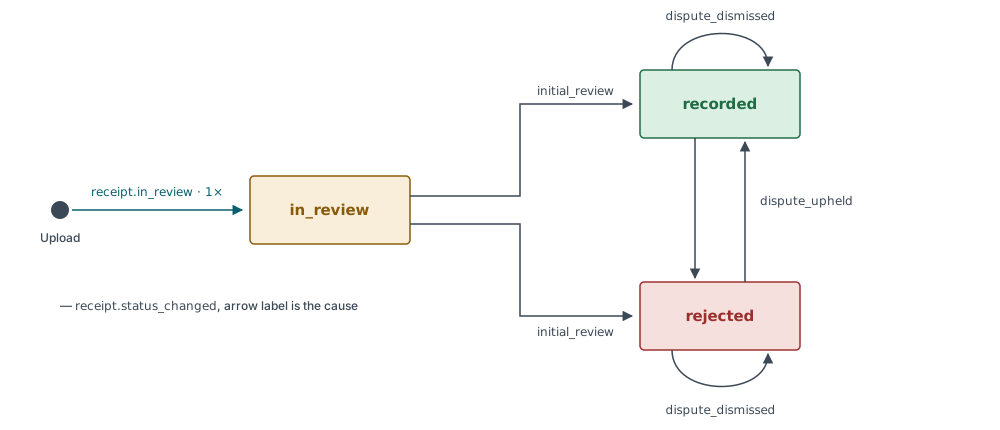
After the upload the receipt is in_review; receipt.in_review says so,
exactly once. Every review outcome arrives as receipt.status_changed, the
arrow is the cause:
cause: initial_review— the first review:recordedwithreimbursementAmount, orrejectedwithrejection.reason.cause: dispute_upheld— the re-review of a disputed receipt changed the outcome; the body carries the new values.cause: dispute_dismissed— the re-review confirmed the outcome; the status stays and the body carries neitherreimbursementAmountnorrejection.
Rules
recordedandrejectedare not final states. A receipt's status always reflects its latest review, so bothrecorded → rejectedandrejected → recordedare possible.- A dispute (
POST /v1/receipts/dispute) has no status of its own: the receipt keeps the outcome it has until the new one is decided. - Entering
in_reviewproduces noreceipt.status_changed. That the review has started is whatreceipt.in_reviewsays, exactly once per receipt — how many review steps it takes stays internal. - Every re-review produces another event for the same receipt id, even when the outcome is unchanged.
- A
reimbursementAmountin a webhook holds as of the delivery time and is never back-filled. It is a share of an allocation period — the day for the meal subsidy, the month for mobility — and changes with the other receipts in that period:- When a further receipt for the same period arrives, the amount on the receipts already recorded might go down.
- When one falls away — deleted, or rejected by a re-review — the amount on the remaining ones might go up.
- No webhook follows for the receipts changed that way; only the receipt that was itself re-reviewed triggers one, and there are no correction events.
- Only
GET /v1/receipts/{receiptId}gives you the current value.
- The order in which deliveries arrive is not guaranteed; deduplicate on
X-Hrmony-Event-Id. Within one receipt,occurredAtorders the events: discard a delivery whoseoccurredAtis older than the state you have already applied for that receipt. There is no sequence number;occurredAtdoes the same job. - A deleted receipt (
POST /v1/receipts/delete) has no status any more, and the deletion produces no webhook.
Receipt status has changed Webhook
Delivered once a review outcome is decided. On cause: "dispute_dismissed" nothing changed: the body carries neither reimbursementAmount nor rejection.
Authorizations:
Request Body schema: application/jsonrequired
| event required | string Value: "receipt.status_changed" |
| occurredAt required | string <date-time> |
| cause required | string What triggered this delivery: Value: "dispute_dismissed" |
required | Receipt stays recorded (object) or Receipt stays rejected (object) |
Responses
Request samples
- Payload
{- "event": "receipt.status_changed",
- "occurredAt": "2026-05-12T09:14:00Z",
- "cause": "initial_review",
- "receipt": {
- "id": "9f3c1a52-7d4e-4b8a-9c11-2f6b8d0a41e7",
- "organizationId": "a1e5c9d0-6b3f-4c2a-8e17-5d9f2b4a7c60",
- "employeeId": "3b7e9f4d-2c1a-4e6b-9d8f-1a5c3e7b9d24",
- "benefitType": "meal_subsidy",
- "status": "recorded",
- "reimbursementAmount": 7.5
}
}In review Webhook
Delivered exactly once per receipt, as soon as it is registered after the upload and therefore in review. The body carries neither status nor reimbursementAmount — the event says that the receipt is being reviewed, not what comes out of it. Not even a dispute repeats it; its outcome arrives as receipt.status_changed.
Authorizations:
Request Body schema: application/jsonrequired
| event required | string Value: "receipt.in_review" |
| occurredAt required | string <date-time> |
required | object (In review) The receipt is in review. Its status stays |
Responses
Request samples
- Payload
{- "event": "receipt.in_review",
- "occurredAt": "2026-05-12T09:14:00Z",
- "receipt": {
- "id": "9f3c1a52-7d4e-4b8a-9c11-2f6b8d0a41e7",
- "organizationId": "a1e5c9d0-6b3f-4c2a-8e17-5d9f2b4a7c60",
- "employeeId": "3b7e9f4d-2c1a-4e6b-9d8f-1a5c3e7b9d24",
- "benefitType": "meal_subsidy"
}
}Test event Webhook
Delivered only when you call POST /v1/webhooks/test — never by anything happening on the platform. The body carries no resource, just the webhookId of the endpoint under test, and every delivery additionally carries the header X-Hrmony-Test: true. It is signed like any other delivery, so you can verify your signature check against it. Never process this event as a business event.
Authorizations:
Request Body schema: application/jsonrequired
| event required | string Value: "webhook.test" |
| occurredAt required | string <date-time> |
required | object |
Responses
Request samples
- Payload
{- "event": "webhook.test",
- "occurredAt": "2026-05-12T09:14:00Z",
- "test": {
- "webhookId": "7e42a9c8-1b35-4d6f-8a20-c93f5e11d874"
}
}